Submersible Pump Service for Deep Wells
Submersible well pump service in the Nampa area: pulling, testing, and servicing deep-set pumps, plus what the valley's water and depth mean for them.
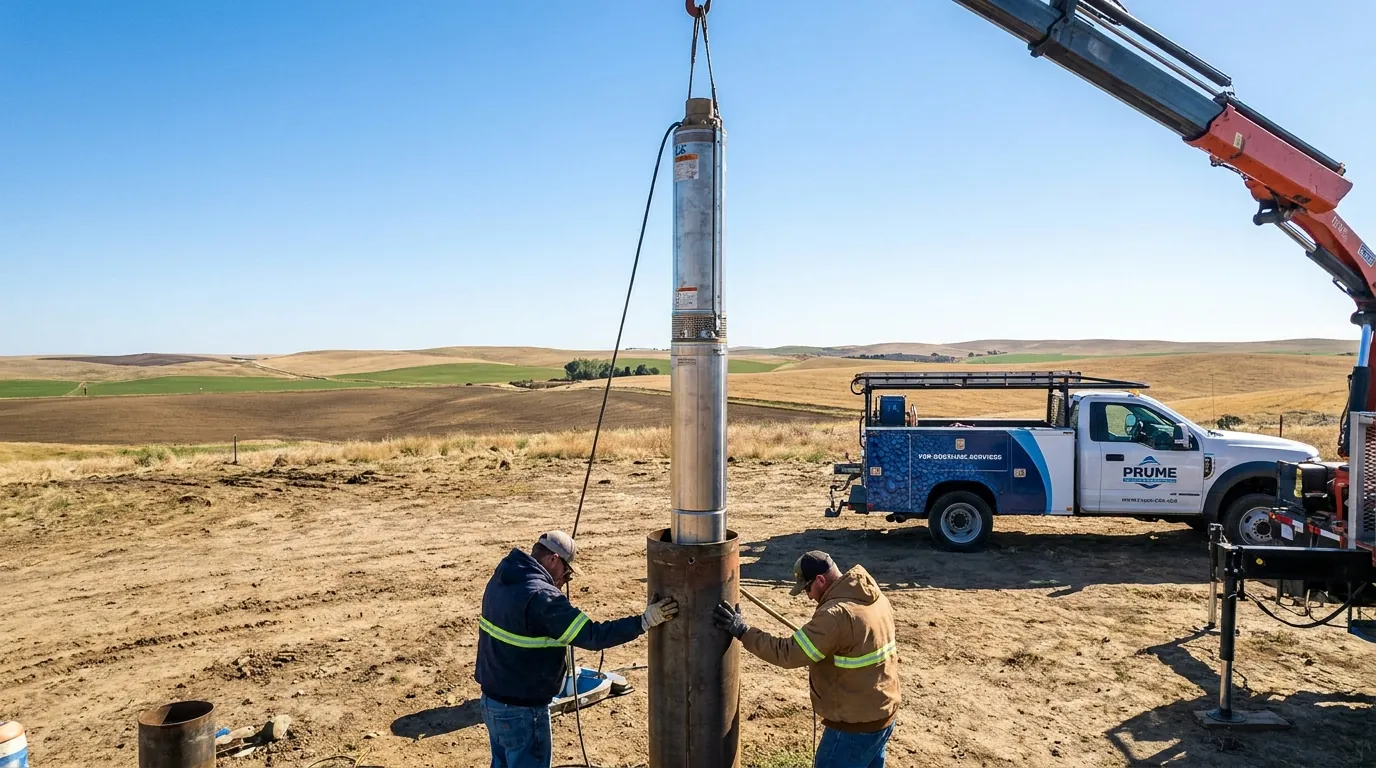
What a submersible pump is and how it struggles
Most modern wells in the Treasure Valley use a submersible pump — a sealed pump-and-motor unit that sits down in the well below the water, pushing water up rather than sucking it. Because it's underwater and out of sight, trouble shows up indirectly: a tripping breaker, no water, air in the lines, or pressure that fades. The pump itself gives no obvious warning until it quits.
Submersible systems have their own failure points — the motor, the capacitor or control box at the surface, the drop wire running down the casing, the splice where wire meets pump, and the check valve. A fault in any of these can masquerade as a dead pump, so the diagnosis has to cover the whole string, not just the pump.
Because the symptoms overlap with other problems, submersible work often starts with the same tests as well pump repair, and when the pump is beyond saving it leads to well pump replacement.
How we service a submersible pump
Surface tests first, then pull only if the evidence calls for it — pulling a deep-set pump is real work, not a first step.
-
Test at the surface
Breaker, control box, capacitor, pressure switch, and tank. Many submersible 'failures' are actually a surface component that never required touching the well.
-
Check the drop wire
We measure insulation and resistance on the wire running down the casing. A grounded or broken drop wire explains a lot of no-water and breaker-tripping complaints.
-
Pull the pump
If the fault is at the pump or motor, we pull the drop pipe, wire, safety rope, and pump — carefully, since deeper valley wells mean more weight and length.
-
Inspect and service
We check the pump for scale, sand wear, and a seized shaft, and inspect the check valve and splice. Worn units in mineral-heavy water often show clear scaling.
-
Reinstall correctly
The pump goes back at the right depth above the well bottom, with a sound splice and a torque arrestor to protect the wire from start-up twist.
Depth, water and winter in the valley
How deep the pump sits is the defining factor in submersible service here. Wells on the bench ground toward Eagle, Star and Kuna can be considerably deeper than valley-floor wells near Nampa and Caldwell, which means a heavier pull and a pump sized to lift water farther. Depth also affects how the pump wears and how long a service visit takes.
The valley's hard, mineral-rich water scales submersible components over the years, and sand-producing wells wear impellers and seals faster. Both show up when a pump is pulled. Above-ground parts of the system — the pressure tank, switch, and wellhead plumbing — are the pieces exposed to cold winters, so a 'pump problem' in January is sometimes a freeze problem at the surface. We rule that out before assuming the trouble is down the well.
Keeping the above-ground side healthy protects the submersible pump: current pressure tank service and a periodic well inspection catch the small issues that otherwise shorten a deep pump's life.
Submersible pump acting up?
We test the whole system from the surface first and only pull the pump when the evidence points down the well — no unnecessary heavy lifting.
Serving Nampa, Caldwell, Meridian, Star, Kuna, Eagle and Boise City.
Frequently asked questions
How do I know if my submersible pump is the problem?
Often you can't tell from the house — no water, a tripping breaker, or air in the lines can all come from surface parts instead. We test the breaker, control box, switch, tank, and drop wire first, and only conclude the pump is at fault after those pass.
Why does a submersible pump need to be pulled?
The pump sits below the water in the well, so to inspect or replace it we bring up the drop pipe, wire, and pump together. We only do this once surface tests and wire readings point to the pump itself.
Does our hard water affect submersible pumps?
Yes. The valley's mineral-rich water leaves scale on impellers and check valves over time, and wells that produce sand wear seals and moving parts faster. Both are common reasons a deep pump loses output as it ages.
Does a deeper well cost more to service?
Generally, yes. A deeper pump means more pipe and wire to pull and a heavier, longer pull overall, plus a pump sized to lift water farther if it needs replacing. Depth is one of the biggest factors in the work involved.